A Guide to Diamond Head Luxury Homes Architecture
May 28, 2026
May 28, 2026
What makes Diamond Head homes so memorable? It is not just the setting. Across Diamond Head, Kapahulu, and St. Louis Heights, you will find a true architectural timeline shaped by hillside lots, ocean air, changing design tastes, and Hawaiʻi’s climate. If you are buying, selling, or simply studying the area, understanding these styles can help you read a property more clearly and appreciate what makes certain homes stand out. Let’s dive in.
Diamond Head / Kapahulu / St. Louis Heights is best understood as a layered residential area, not a neighborhood with one signature look. Diamond Head Terrace was platted in the early 1920s, and many individual owners built on those lots over time. That pattern created a mix of Craftsman, Spanish Colonial or Mission Revival, Monterey, Mediterranean Revival, Tudor, French Norman, Colonial Revival, Hawaiian style, and Cotswold cottage homes.
That variety is a big reason the area feels so distinctive today. One block may show pre-war revival architecture, while another shifts toward postwar modernism or late 20th-century custom design. In Kapahulu, the core of the avenue also developed its own late-1930s and 1940s Art Moderne character, which adds another layer to the district’s story.
Some of the most visible older homes in the area are bungalows and Craftsman-influenced residences. These homes often feature exposed rafters, decorative corbels, and practical forms that feel grounded and welcoming. In Diamond Head Terrace, examples such as 3035 Kiele Avenue and 3004 Kiele Avenue show how bungalow forms were adapted with local and revival-style influences.
These houses often feel comfortable rather than formal. Their massing is usually compact, and their details tend to reward close attention. For buyers and sellers, that means their appeal often comes from craftsmanship, proportion, and original character rather than sheer scale.
Tudor and French Norman influences also appear in Diamond Head Terrace and St. Louis Heights. These homes often use steep gable or hipped roofs, half-timber details, stucco walls, board-and-batten cladding, and casement windows. On hillside lots, interiors may include split levels or changes in ceiling height that respond directly to the slope.
A documented example is the 1931 house at 3029 Felix Street in St. Louis Heights. It was described as a half-timber and stucco residence with multiple floor and ceiling levels shaped in part by the hillside site. That kind of adaptation helps explain why older homes here often feel closely tied to the land rather than imposed on it.
One of the most important local architectural expressions in the district is Hawaiian style. This style is not just decorative. It reflects a practical response to heat, light, ventilation, and indoor-outdoor living.
A notable example is the duplex at 3040 Diamond Head Road. It is described as a Hawaiian-style house with double-pitched hipped roofs, abundant casement windows, open beam living rooms, and an H-shaped layout designed to improve ventilation and daily use. The nomination also notes that this roof form was introduced to Hawaiʻi in 1926 by C. W. Dickey.
You may also notice plantation-era vernacular influence across Honolulu that carries into this area’s residential character. Features such as simple construction methods, practical layouts, and later details like carports shaped how homes evolved over time. Even when a home is not purely plantation-style, these influences can still show up in the way it handles airflow, shade, and everyday use.
For a modern buyer, these design choices often feel timeless because they solve real climate needs. Good cross ventilation, shaded openings, and a strong connection to a lanai or outdoor area are not just aesthetic qualities. They are part of how a home lives well in Honolulu.
Diamond Head Terrace also includes a strong Mediterranean and Spanish-influenced group of homes. These residences often feel more ornamental than the simpler Hawaiian-style bungalows nearby. You may see white stucco exteriors, rounded clay roof tiles, arches, and compact but carefully composed facades.
The residence at 3001 Diamond Head Road is described as a Spanish Mission Revival cottage with white stucco, rounded clay roof tiles, and repeated arches. Another property, 2927 Hibiscus Place, is identified as a bungalow with Spanish or Mediterranean influence. Together, these homes show how outside design trends were adapted to local living patterns.
Although these revival homes draw from European precedents, they still share Hawaiʻi-specific traits. Porch life, outdoor circulation, and relatively compact massing remain important. That blend of ornament and livability is part of what gives these homes lasting appeal.
For sellers, architectural clarity can matter when presenting a home to the market. Buyers often respond strongly when a property has recognizable design language and details that feel intact. In this area, style identity is often part of the home’s overall story.
St. Louis Heights began when land sold off from Saint Louis School was subdivided in the 1920s. Because of the terrain, homes here often reveal a more direct relationship to topography than houses on flatter lots. You will often find staggered floor levels, terraces, and layouts that step with the hillside.
That site-driven design can create homes with a strong sense of individuality. Open beam ceilings, changes in elevation, and carefully placed windows often make these residences feel dynamic from room to room. In practical terms, the hillside is not a limitation here. It is part of the architecture.
Kapahulu adds a different chapter to the area’s architectural story. The core of Kapahulu Avenue developed a late-1930s and 1940s Art Moderne pattern, which stands apart from the residential revival styles found closer to Diamond Head Terrace. This gives the broader district a more urban and stylistically varied identity.
Art Moderne is often associated with smoother forms and streamlined design. In Kapahulu’s case, this pattern contributes to a continuous street wall and a closer storefront-to-sidewalk relationship. Even if you are focused on homes rather than commercial streetscapes, that built character shapes how the district feels as a whole.
Diamond Head is not limited to cottages and revival homes. The residence at 3024 Diamond Head Road is a rare Honolulu example of a 1930s Streamline Moderne house. It features rounded corners, a flat built-up roof, and concrete masonry walls.
This kind of house helps explain why the area can feel eclectic even before the postwar era. It also shows that modern design ideas were already entering the neighborhood well before mid-century architecture became more widespread.
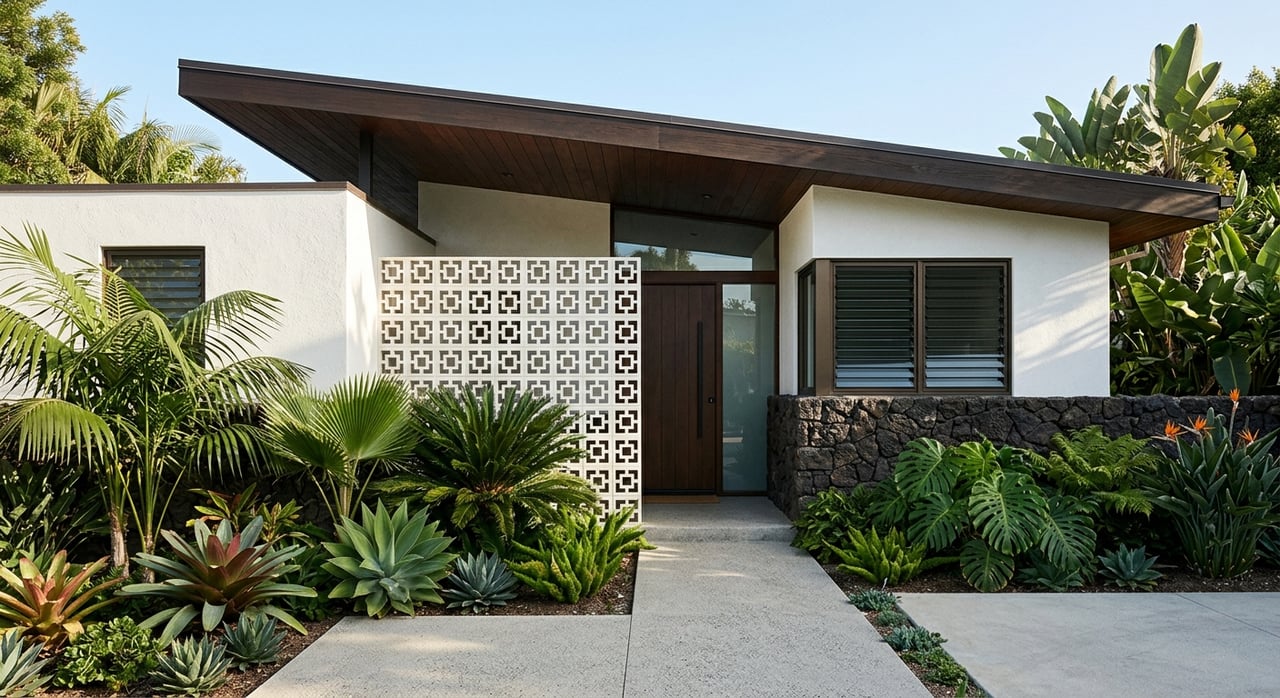
After World War II, the district shifts more clearly toward modernism and Hawaiʻi Regional design. The Frederick and Alice Johnson residence from the 1940s is noted for built-ins, local materials, and strong indoor-outdoor relationships. The Cloward Residence, remodeled in 1949, is described as a mid-20th century Hawaiʻi Regional house with steep double-pitched roofs, overhangs, board-and-batten cladding, open eaves, and grouped double-hung windows.
Another example is the 1961 David Barry Jr. Resort Home, which uses separate pavilions, lanais, and an open walkway to connect the home to its site. In homes like these, large windows, sliding doors, and lighter exterior forms become central to the design language. The result is architecture that often feels open, site-aware, and tailored to island living.
At the newer end of the timeline, Diamond Head also includes bold custom residences. These homes are often highly site-specific, using scale, material, and geometry to engage directly with the property’s slope, views, and landscape. In luxury real estate, that architectural intention can be a meaningful part of a property’s identity.
A strong example is the Joseph and Joan Farrell Residence at 3196 Diamond Head Road, completed in 1984. It is described as Tropical Brutalism, with bare concrete, geometric massing, and a deliberate integration of foliage, openness, and natural ventilation into the slope of Diamond Head. This is a clear reminder that newer architectural significance in the area can be just as compelling as its pre-war history.
In this area, the most successful homes often make climate and topography part of the design. Historic records repeatedly emphasize cross ventilation, lanais, open beam ceilings, abundant windows, and indoor-outdoor circulation. On hillside lots, staggered floors and terraces help the house fit the land rather than resist it.
That matters because good architecture is not only visual. It affects how a home feels in daily life. Buyers often respond to homes that balance beauty with shade, airflow, and a natural connection to the outdoors.
Architectural recognition can also shape how a property is perceived over time. According to the State Historic Preservation Division, register listing can provide formal recognition, neighborhood planning value, possible tax exemptions, grants, and technical assistance. Diamond Head Terrace has a dense cluster of recognized historic houses, so architectural pedigree here is often more than a design note.
For owners, that means a home’s style and integrity may contribute to its long-term identity. For prospective buyers, it adds context that can help explain why one property feels especially scarce or memorable compared with a more generic home elsewhere.
When you evaluate an older home in Diamond Head, Kapahulu, or St. Louis Heights, the style label is only part of the picture. Renovation potential depends more on historic integrity and whether the property is subject to review. The State Historic Preservation Division says alterations to listed properties go through 6E-10 review, and certain permit-triggered projects can also trigger 6E-42 review.
The City and County of Honolulu Land Use Ordinance also includes a Diamond Head special district with prominent views, design controls, and project classification. So even when a property is not a landmark, exterior changes in and around the district may involve added review considerations.
Historic records also show that thoughtful updates can still respect the original architecture. The nomination for 3040 Diamond Head Road notes that the house was altered over time but remained readily recognizable as a duplex, with additions handled in a sympathetic manner. That is a useful standard for anyone considering changes.
In practical terms, the strongest renovations here often preserve the original form, roofline, windows, and material character while improving function for modern living. If you are buying with plans to renovate or preparing a legacy property for sale, that balance matters.
If you are evaluating a Diamond Head property, architectural context can shape everything from first impressions to renovation strategy. For discreet guidance on how style, integrity, and presentation may affect a home’s position in the market, connect with Cedric Choi.
Explore additional stories, insights, and market updates from our team.
Partner with Honolulu luxury real estate leaders for a seamless, results-driven experience backed by global reach.
GET IN TOUCH
ADDRESS 4614 KILAUEA AVE SUITE 201 HONOLULU HI 96816